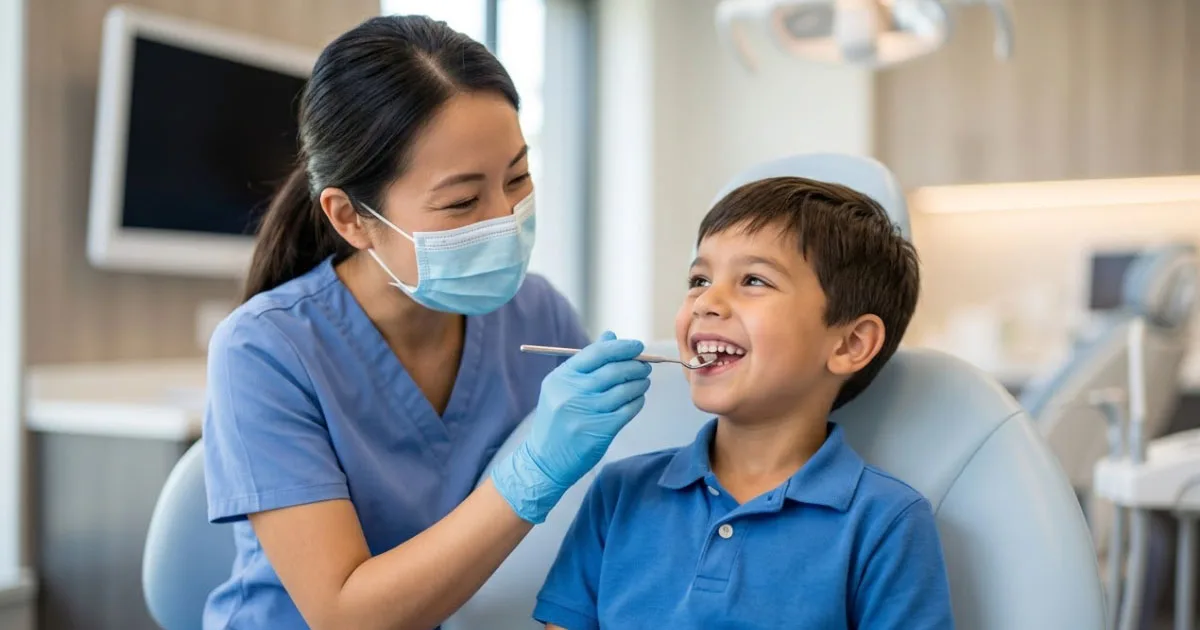
Crooked or crowded teeth in a young child are not always a problem with the teeth themselves. In some children, the upper jaw is narrower than it should be, so there is simply not enough room for the adult teeth as they come in.
A narrow dental arch is easier to manage while a child is still growing. Here is what causes it, the signs to watch for, and how the Invisalign Palatal Expander and Invisalign First can help.
What Is a Narrow Dental Arch?
The dental arch is the curved row your teeth sit in. When the upper jaw (maxilla) is too narrow, the arch lacks the width for all the permanent teeth.
Adult teeth are larger than baby teeth, so a jaw that seemed fine at age five may run short of space once the permanent teeth start coming in. A narrow upper jaw can also mean the upper and lower teeth do not meet properly when your child bites down.
What Causes a Narrow Upper Jaw in Children?
- Genetics: Jaw size and shape are partly inherited. If a parent had crowded teeth or a narrow jaw, a child may develop a similar pattern.
- Thumb, finger or pacifier sucking: A strong habit that continues as the permanent teeth develop can put steady pressure on the roof of the mouth and the upper teeth, affecting how the jaw grows.
- Mouth breathing: When a child regularly breathes through the mouth, the tongue tends to rest low instead of against the roof of the mouth. Mouth breathing and a narrow upper jaw often occur together, and research suggests each may influence the other.
- Tongue posture and tongue-tie: A tongue that cannot rest comfortably against the palate may also play a part in how the upper jaw develops.
What Signs Should Parents Look Out For?
These signs are worth mentioning to a dentist:
- Crowding: Permanent teeth coming in overlapped, twisted or pushed out of line.
- Crossbite: Some upper teeth sit inside the lower teeth when your child bites, sometimes on one side only.
- Mouth breathing: Lips often apart, or breathing through the mouth during the day.
- Snoring or noisy breathing at night: This can sometimes be associated with a narrow upper jaw, but it has many possible causes, such as enlarged tonsils or adenoids. A child who snores regularly should also be checked by a doctor.
- A high, narrow palate: A roof of the mouth that looks deep and V-shaped rather than broad.
These overlap with other early signs of orthodontic problems in children.
Why Does Treating a Narrow Jaw Early Make a Difference?
In children, the upper jaw is made of two halves joined by a seam of tissue in the middle of the palate. While a child is still growing, this seam has not fully fused, so gentle, controlled pressure can widen the jaw itself rather than only tipping the teeth outwards.
As children get older, the seam matures and becomes harder to separate, so widening the jaw later may need more complex approaches. That is why timing matters. Even so, early treatment is not right for every child, and some are best monitored until more permanent teeth come through.
How Do the Invisalign Palatal Expander and Invisalign First Work Together?
For children who need it, treatment can combine two removable appliances.
Widening the upper jaw with the Invisalign Palatal Expander (IPE)
The IPE is a series of custom, 3D-printed removable expanders made from a digital scan of your child's teeth. Each one is set to widen the upper jaw by a small amount. Your child wears it full time, including while eating, and removes it to brush. The expanders are changed in a sequence your dentist sets, without the screw-turning needed with traditional metal expanders. Once the target width is reached, holding devices keep the jaw stable while it settles. Align describes the IPE for children of around 7 to 10 years old, although readiness depends on how the teeth have developed.
Guiding the teeth with Invisalign First
Invisalign First is a clear aligner system designed for younger children who still have a mix of baby and adult teeth. It can develop the dental arch, make room for erupting permanent teeth and align the teeth at the same time. Children are usually suitable once their first permanent molars have come through and at least two of the front adult teeth are largely through. Like other Invisalign treatments, the aligners need to be worn for most of the day, so parental support matters.
Not every child needs both. Some need only aligners, and some need no treatment at this stage.
How Can Pallx Dental Help Your Child?
For parents considering Invisalign in Johor Bahru (JB) for a younger child, experience with growing patients matters. Pallx Dental is a dental clinic in Johor Bahru and an Invisalign Diamond Provider in 2025, and our team has managed close to 500 Invisalign cases across children, teenagers and adults.
- Early orthodontic focus: Our founder holds a Postgraduate Diploma in Orthodontics, completed with a focus on early orthodontics and dentofacial orthopaedics.
- Certified Invisalign providers: Most of our dentists are certified Invisalign providers, so your child's treatment is planned by a team familiar with the system.
- Digital scanning: We use iTero scanning, so there is no need for traditional impression trays, and parents can see a 3D view of their child's teeth on screen.
- Treatment only when needed: If your child does not need treatment yet, we will tell you, and suggest when to review again.
Not Sure If Your Child Needs Treatment?
If you have noticed crowding, a crossbite or regular mouth breathing, a check can give you clarity. We offer a free consultation for children's orthodontic assessments, where our dentists examine your child's teeth and jaw and explain the options. You can book a consultation with our team in Johor Bahru.